
Aethenics — Exploring the Systems That Map the Mind
Throughout history, people have developed systems to understand the relationships between the mind, knowledge, nature and the universe. Aethenics draws inspiration from these traditions, not to reproduce them, but to explore how their ideas might connect through a contemporary framework of Meta Coding, Creative Indexing and the Cognitive Positioning System & Aethenic Atlas.
The Seven Liberal Arts provide one of the clearest starting points. Grammar, Logic and Rhetoric form the Trivium, concerned with language, reasoning and communication. Arithmetic, Geometry, Music and Astronomy form the Quadrivium, concerned with number, proportion, harmony and the cosmos. Together, they offer a historical model for connecting different disciplines into a unified approach to learning.

The Seven Hermetic Principles, presented in The Kybalion, offer a different perspective through Mentalism, Correspondence, Vibration, Polarity, Rhythm, Cause and Effect, and Gender. These principles explore philosophical relationships between mind, change and the structure of experience. In Aethenics, they provide ideas to question and investigate, particularly the principle of Correspondence: whether relationships identified in one system can help us understand another.

Platonism and the Allegory of the Cave invite us to question the difference between appearance and reality. What we perceive may not reveal the whole picture, and what we believe may depend on the perspective from which we observe it. This connects directly with the Oculus: a space for examining assumptions, questioning interpretations and considering the relationship between thought and the observer of thought.
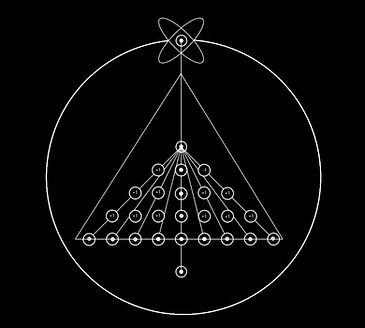
Pythagorean philosophy explores the relationships between mathematics, geometry and musical harmony, suggesting that numerical proportions can reveal patterns shared across different fields. This connects with the Aethenic view of the mind as something that can be explored through rhythms, cadences, ratios and symbolic structures. The Pythagorean Tetractys, with its ten points arranged in a triangle, provides a particularly interesting example of how a simple geometric form can represent a larger conceptual system.

The Seven-Chakra Model, found in some Indian spiritual traditions and adapted in various modern interpretations, offers a further comparison through its seven principal centres. It demonstrates how a system can organise experiences and ideas through a sequence of symbolic associations. Aethenics can examine such models alongside its own colour indexing and conceptual structures, while distinguishing traditional interpretations from claims supported by scientific evidence.

Kabbalah and the Tree of Life provide another example of symbolic mapping. Its ten sefirot and their relationships form a traditional framework for contemplating creation, attributes and interconnectedness. For Aethenics, it illustrates how abstract ideas can be organised visually, allowing relationships to be explored through a structured symbolic language.
Other sevenfold systems offer additional points of comparison. The seven classical planets connect historical cosmology with cycles and symbolic associations; the seven musical notes provide a practical way to explore pitch, intervals and harmony; and the seven-day week connects historical planetary naming traditions with the organisation of time. The seven virtues and seven vices offer a framework for examining ethical qualities, opposing tendencies and human behaviour. These systems differ considerably in origin and purpose, but each demonstrates how a limited set of elements can be organised into a meaningful structure.
Bringing the systems together
Aethenics does not claim that these traditions are identical, that they all share seven universal laws, or that symbolic similarities establish scientific truths. Instead, it asks what we can learn by comparing their structures, questioning their assumptions and exploring the relationships between them.
Through the Cognitive Positioning System & Aethenic Atlas, participants use language, numbers, colours, shapes, sounds and symbols as tools for investigation. AI can assist in generating questions, comparing interpretations and developing visual prototypes, while critical thinking helps distinguish meaningful discoveries from coincidence or unsupported association.
The purpose is not simply to learn what previous systems taught us, but to investigate how we form knowledge, interpret meaning and understand our own minds.
Aethenics brings these historical traditions into a contemporary, exploratory practice centred on one fundamental question:
What is the mind, and how can we learn to understand it?
